


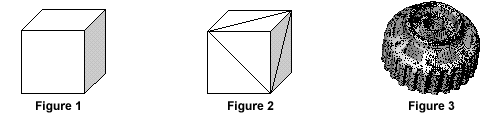
The STL file format was invented by Chuck Hull, founder of 3D printing and 3D Systems, in 1986. The STL has become the 3D printing and Rapid Prototyping industry's defacto standard data transmission format. This format approximates the surfaces of a solid model with triangles. For a simple model such as the box shown in figure 1, its surfaces can be approximated with twelve triangles, as shown in figure 2. The more complex the surface, the more triangles produced, as shown in figure 3.
Almost all of today's CAD systems are capable of producing an STL file. For the user the process is often as simple as selecting File, Save As, and STL. Below are steps for producing high quality STL files from a number of today's leading CAD systems. In all cases, export your STL file as a Binary file. This saves on time and file size.
As a general rule, changing options such as Chord Tolerance or Angular Control will change the resolution on your STL file. The larger the STL file, the more triangles placed on the surface of the model. For simple geometry (not a lot of curves), the file may only be a couple hundred kilobytes. For complex models, files sizes in the range of 1-5MB will produce good parts. For many geometries, files larger then 5MB are unnecessary and will often just result in more time to get your quote and parts back.
Also, for most 3D printing processes and materials, the minimum feature thickness is 0.020. Anything less than this and features will not develop. Please check your models and make appropriate changes to critical features. An exception is the High Resolution SLA, which will make features down to 0.010 and the SLS Flex material, which needs 0.040 thickness to produce features.
(Please note, these are only general guidelines and may not work or produce the best possible STL file in some cases. Please consult your user's guide or the software's developers for more information or technical support.)
3D CAD SOFTWARE THAT SUPPORTS STL FILE CREATION FOR 3D PRINTING